Why A Power Cut At A Factory Is More Expensive Than It Looks
Industrial UPS Manufacturer in India explains how the right UPS protects factory production, data, CCTV and critical systems during sudden power cuts.
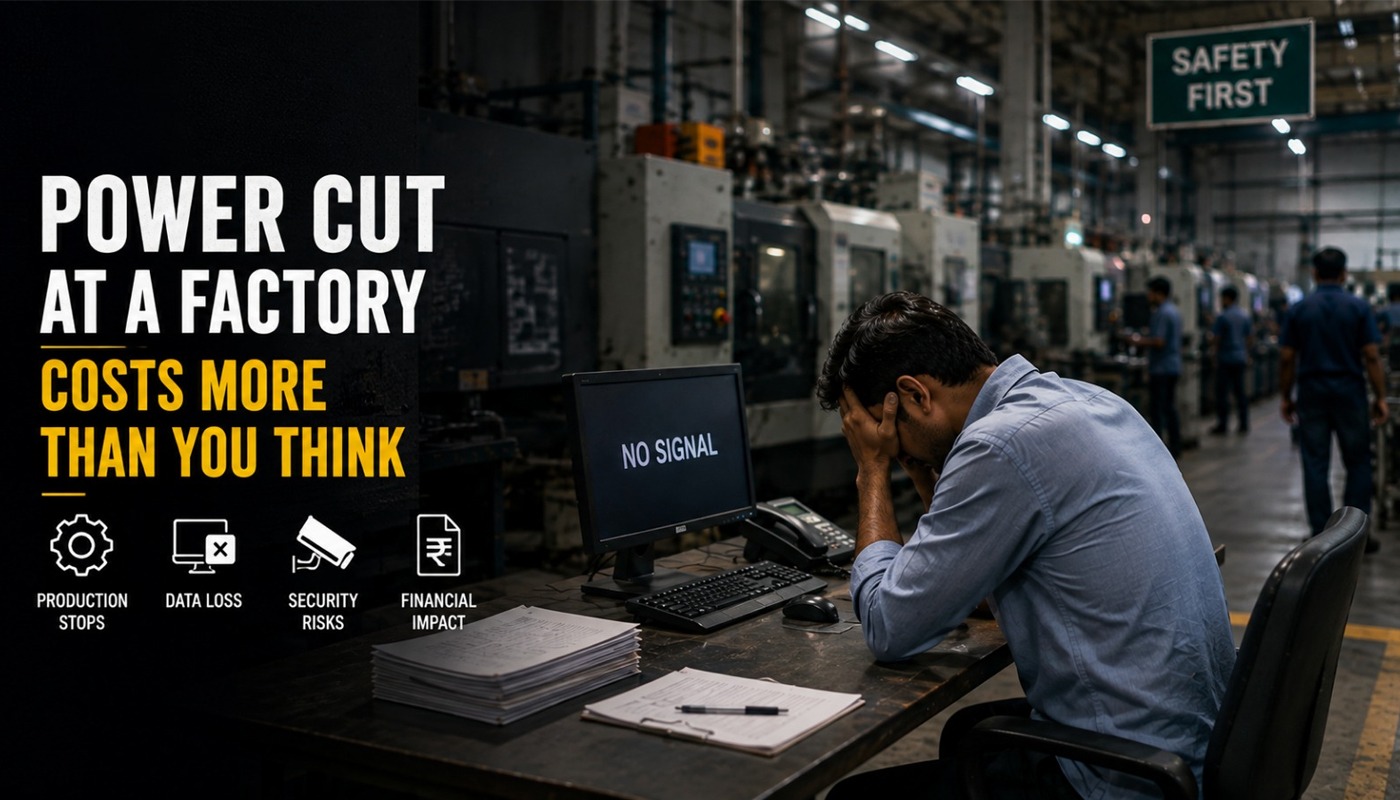
A power cut inside a factory rarely stops at the lights. Machines pause, computers shut down, billing slows, CCTV goes offline, and production records may be interrupted. For this reason, choosing the right Industrial UPS Manufacturer in India is not only an electrical decision. It is also part of protecting daily operations.
Even a short outage can create more work than expected. The real cost often appears after the power returns.
Why An Industrial UPS Manufacturer In India Looks Beyond Backup Time
Factories use power in many different ways. Some equipment supports production, while other systems handle billing, data, security, or communication.
When power fails, several processes may stop at the same time. For example, a production machine may shut down safely, but the connected computer may lose an unsaved job. Meanwhile, the billing desk may stop working and CCTV recording may also pause.
So, backup planning should begin with one question:
Which systems cannot afford to stop?
Once that is clear, the UPS can be planned around the real business need.
Production Stops, But The Cost Keeps Growing
The most visible loss is production time.
If a machine stops for 15 minutes, the factory may lose more than those 15 minutes. Workers may need time to restart the equipment. In addition, the machine may require checks before production begins again.
Raw material may also remain inside a process when the power fails. Depending on the application, that can lead to wasted material or extra inspection.
Therefore, downtime should not be measured only by the duration of the outage.
Computers And Production Data Need Protection Too
Modern factories depend on computers almost as much as machines.
Production records, inventory systems, ERP software, billing, attendance, and order details may all rely on powered systems. A sudden shutdown can interrupt these tasks.
A properly planned 3 Phase Online UPS can support critical equipment where stable and continuous power is needed. However, the system must match the actual load and application.
Not every device needs UPS backup. The goal is to identify the equipment that affects operations most.
CCTV And Security Can Also Go Offline
Security systems are easy to forget during backup planning.
Factories may use CCTV, access control, alarms, and network devices throughout the site. If these systems stop during an outage, the business may lose visibility at the exact time it needs it.
For this reason, security loads should be part of the UPS discussion.
A reliable UPS Manufacturer in India should ask about these smaller but important systems instead of looking only at large machines.
Restarting A Factory Takes Time
Power returning does not mean production returns at the same moment.
Some machines need manual restart. Computers may need to reboot. Network systems must reconnect. Operators may also need to check whether a process stopped safely.
As a result, a five-minute outage can create a much longer break in work.
This is where continuous backup becomes useful. A suitable industrial UPS gives critical systems time to keep running or shut down safely.
Why Load Planning Comes First
Buying a larger UPS does not automatically solve every problem.
First, list the loads that need protection. Then separate them into groups.
For example:
- Production control systems
- Servers and computers
- CCTV and security
- Billing equipment
- Network devices
- Critical machines
After that, calculate how much power these systems need. Also check how long they must remain active.
A good Industrial UPS Manufacturer in India should help match UPS size with the actual load instead of suggesting capacity only by guesswork.
Where A 3 Phase Online UPS Makes Sense
A 3 Phase Online UPS can suit industrial setups with higher loads and equipment that needs steady power.
Because an online UPS continuously supplies conditioned power through its conversion system, it can help protect sensitive loads from interruptions and certain power-quality issues.
Still, the correct choice depends on the application. Load type, capacity, backup time, input supply, and future expansion should all be checked before installation.
The biggest UPS is not always the best UPS.
The right one is the system that fits the factory.
Aerowolt’s Approach To Industrial Backup
At Aerowolt, we look at power backup as part of the complete operation.
The first step is understanding what the factory needs to keep running. After that, the load, backup time, power condition, and equipment type can guide the UPS choice.
As an Industrial UPS Manufacturer in India, Aerowolt focuses on practical system planning rather than capacity alone.
A well-planned UPS does more than keep equipment on.
It helps reduce the disruption that begins when the grid goes off.
Final Thoughts
A factory power cut can affect production, data, billing, security, and customer commitments at the same time.
That is why industrial backup should not be planned only around how long the lights need to stay on.
Start with the critical load. Then check the required backup time, equipment type, and power conditions.
With the right Industrial UPS Manufacturer in India, a factory can build a backup system around the areas where downtime creates the biggest business impact.
Frequently Asked Questions
1. Why Does A Factory Need An Industrial UPS?
An industrial UPS can keep critical machines, computers, servers, CCTV, and control systems running during power problems.
2. What Is A 3 Phase Online UPS?
A 3 Phase Online UPS is designed for three-phase electrical systems and can support higher industrial loads that need stable power.
3. Can One UPS Support The Whole Factory?
It depends on the total load. In many cases, factories protect only critical systems instead of connecting every device.
4. How Do I Choose The Right UPS Capacity?
Start by listing the equipment that needs backup. Then calculate its total load and the backup time required.
5. Does A Bigger UPS Always Give Better Backup?
No. Backup also depends on battery capacity, connected load, system design, and required runtime.
6. Why Choose Aerowolt As An Industrial UPS Manufacturer In India?
Aerowolt focuses on the load, application, backup need, and operating conditions before recommending an industrial UPS solution.